


Optimising Performance and Longevity of Electric Load Handling Equipment through Expert Service
Key Takeaways
- A Reachstacker is not a Tesla: Unlike consumer EVs, heavy industrial machines operate under extreme mechanical stress. While you can expect a 20-25% reduction in maintenance costs, regular service remains vital for load-handling components and hydraulic systems.
- The High-Voltage Safety Shift: Transitioning from 24V to 600–800V systems demands rigorous new safety protocols. Working on high-voltage equipment is safe and straightforward, but only when performed by trained technicians following precise manufacturer documentation.
- Maintenance-Free Batteries still need Care: Li-ion battery modules are largely maintenance-free and designed to last the machine's lifetime. However, they require scheduled checks of thermal management systems and electrical insulation to maintain optimal state-of-health.
- Strategic Infrastructure: Charging systems are now mission-critical terminal infrastructure. Maintenance teams must understand interoperability between chargers and machines to prevent unplanned downtime.
- The Power of Data: Tools like MyKalmar INSIGHT allow operators to monitor battery health in real-time, enabling proactive maintenance and smarter charging cycles to extend equipment life.
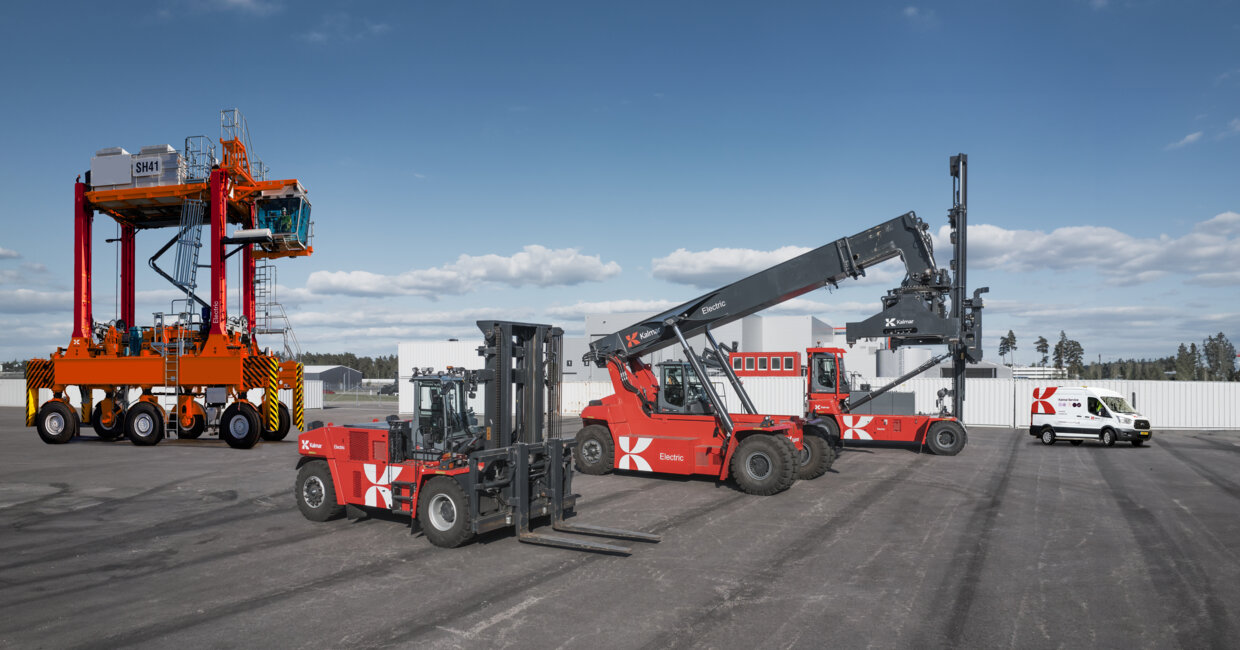
Ports, terminals and other companies in the logistics and material handling industries are currently in transition to fully electric (battery-powered) equipment.
Although smaller machines such as light forklift trucks have been battery-powered for many years, the electrification of heavier classes of industrial equipment including reachstackers, straddle carriers and heavy forklift trucks has taken longer to reach maturation.
The electrification of heavy container and material handling equipment has been driven by the rapid development of high-voltage Lithium-ion (Li-ion) battery technology, and, more specifically, its incremental adoption in heavy road vehicles and buses. Although technically very different from port and terminal equipment, heavy road vehicles have served as the mass-market testbed for the battery and charging technologies that enable the electrification of heavy equipment.
Electrification offers up to 90% reduction of equipment lifetime emissions.
From a maintenance perspective, battery-electric equipment introduces numerous new requirements for all levels of the business, from service organisations to local maintenance teams and individual technicians. These can be summarised mostly as a crucial need to acquire new specialist competence to work safely on high-voltage Li-ion battery systems, either through in-house training or by sourcing the work to the equipment manufacturer or a service partner. When maintained according to the appropriate instructions and safety guidelines, battery-electric equipment is straightforward and extremely safe to work on, but the correct procedures must be followed at every step.
Battery-electric equipment also introduces changes to the type and frequency of maintenance work carried out on equipment fleets. The removal of the diesel drivetrain from the machine will lead to less scheduled maintenance, as engine oil and filter changes are no longer required. However, most of the wear and tear on the machine’s load handling components and other systems will still be exactly the same on a battery-electric machine, so the difference in scheduled maintenance requirements will not be as dramatic as, for example, on a consumer electric car.
On electric machines, planned preventive maintenance becomes increasingly important. The battery modules on an electric machine are essentially maintenance-free, but they require scheduled checks by qualified technicians to ensure safe operation and optimal performance. Due to the complexity of the maintenance procedures on high-voltage battery-powered equipment, terminal operators may find it advantageous to have the service of their electric equipment handled by the manufacturer or an expert service partner, instead of developing all the required competence in-house.
Why Expert Service Matters
Because of the complexity of high-voltage systems, many terminal operators find it advantageous to partner with an expert service provider. This ensures access to the latest technical training and documentation without the need to develop all specialist competencies in-house.
Read more about this topic in our EV Care whitepaper.
About the authors

Related articles
Further reading
Subscribe and receive updates in your email
Subscribe